The peak of pollen allergy is coming again. Why is it overwhelming?
Atchoo! Obviously, it is spring and sunny, but for many people, it means a difficult test-pollen is coming!
Who is the culprit?
When it comes to "pollen", what pops into our minds is mostly the colorful colors.
In fact, the flowers with bright colors and eye-catching flowers are mostly insect vectors, and their pollen is large and pollinated by sticking to animals such as insects. Such pollen is not easy to float in the air and be inhaled by us to cause allergies, so they are not the main cause of pollen allergies.
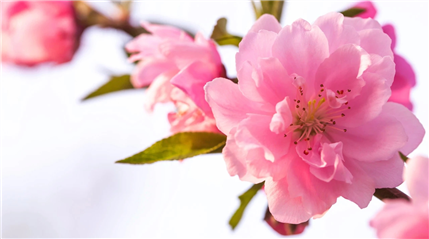
The murderer who really makes us cry comes from some trees or grass. Their flowers are very inconspicuous, mainly relying on wind media, which can produce a huge amount of fine, small and light pollen, which is spread everywhere by the wind. They are the real murderers who cause our allergies.
Why is pollen overwhelming?
The pollen of wind-blown flowers is huge and small and light, so how much and how light are these pollen?
Let’s take the pollen of a fir tree as an example.
Cut a branch with cones from a fir tree, about 20 cm long, count the number of cones on it, and then convert it, and you will find that there are almost 1 billion pollen in this branch! If we calculate to a whole fir tree or even a fir forest, the number of pollen is simply astronomical.
So how small and light is the cedar pollen?
The "size" of fir pollen is about 30 microns (0.03 mm), and the falling speed is about 2 cm/s in the absence of wind, that is, it takes nearly 1 minute to fall 1 meter. If there is a wind during the fall, the pollen can immediately become a flying body. In other words, pollen can use air resistance to counteract the gravity of the earth and travel long distances in the updraft.
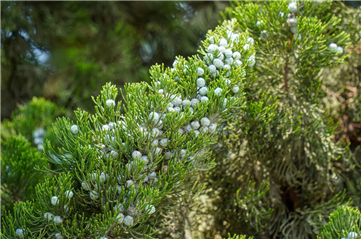
The pollen of other wind-blown flowers is similar to that of fir trees in principle, so I won’t go into details here. For example, the common Sabina vulgaris in China will also have this kind of situation.
What is the use of pollen?
Although pollen allergy sufferers can’t wait for these annoying allergens to disappear, in fact, pollen is still very useful. In addition to the plant’s own family, pollen itself can be said to be a "good clue".
Just as the flowers of different kinds of plants have different beauty, the pollen of different kinds of plants also has different sizes, different shapes and different shapes. Therefore, in some cases, we only need to look at the pollen to deduce which kind of plant it is (note: classification by pollen alone has certain limitations and it is difficult to be accurate).
The outer walls of pollen and spores are composed of a polymer organic substance with extremely stable chemical properties. This substance is called sporopollen, which can’t be dissolved with strong acids and alkali such as hydrochloric acid and sodium hydroxide. Therefore, many times scientists can observe well-preserved ancient pollen or spores under the microscope after treating the soil in swamps and wetlands with acid, alkali, hydrofluoric acid and other substances.
In other words, if we investigate the pollen remaining in the stratum, we may be able to infer all kinds of information in the past. This knowledge of pollen analysis is called palynology. Through palynological analysis, we can draw the pollen distribution map in the soil, analyze the past vegetation changes from a quantitative point of view, and infer the climate changes at that time. In other words, pollen can provide us with information about the origin of human agriculture and the subsequent vegetation destruction, oil and coal mining and environmental changes.
In addition, in the detection of cases, the trace of pollen in the inconspicuous corner sometimes brings wonders, because the unique flowers in some places can expose the whereabouts of suspects.

However, no matter how useful pollen is, and how interesting it is to study its history, pollen is still unbearable for people who are allergic to pollen.
Source: CCTV news client
Editor: Zhang Qianjia